
Publications & Software
Focus Statement
The ability of neurons to coordinate behavior is amazingly . A single neuron's activity Neural circuits exhibit incredible robustness in the face of perturbations, owing both to their endogenous fault-tolerance, and homeostatic regulation processes. Circuits are also incredibly flexible, adapting their activity to different contexts based on top-down control signals and bottom-up feedback. How do circuits balance these crucial but competing demands of robustness and flexibility over multiple timescales? My thesis research contributes to this investigation by addressing the following questions: (1) under what circumstances can simple, local regulation rules rescue complex behavioral dynamics, (2) how can circuits ensure consistency, not just of their current dynamics, but in their response to control signals across varied situations, and (3) as animals flexibly switch between behaviors, can the same local regulation rules still function effectively?List of Publications
Projects
- Neural Parameter Space Degeneracy: there are many ways to configure a nervous system's components to produce the same desired outcome (a.k.a. adaptive behavior)
- How is the variability between the neural parameters of individuals structured? Do organisms actually make use of all theoretically acceptable configurations of their components?*
- How do processes like development, neuromodulation, disease, and homeostatic plasticity, change a system's position in that space of possibilities? For better or worse?
- The nature of degeneracy means that organisms have limited information about their current state. Can they still effectively guide their behavior despite this limitation?*
- How can organisms balance their robustness to unwanted external perturbations, while responding flexibly to their environment when appropriate?*
- Motor Pattern Generators: Rhythmic movements are essential in most brain-body-environment systems
- Many rhythmic motor patterns (e.g. the Aplysia feeding cycle) exhibit cycle-to-cycle variability. What kinds of environmental perturbation might underly this variability, and what kinds would be "averaged away"?*
- Olfaction requires thatregular breathing rhythms be co-opted for sniffing. What is the mechanism behind this control, and how is it shaped by incoming odor information to produce adaptive behaviors like navigation and source differentiation?
- What tools from dynamical systems theory are most useful for describing these patterns in situated, embodied organisms?
- Activity-dependent Homeostatic Plasticity: Neurons and neural circuits must maintain stable activity levels in the face of constant internal and external perturbations
- How do neurons use local information to globally regulate their activity levels?*
- What are the dynamical consequences of different homeostatic mechanisms on single neurons and neural circuits?*
- How do different homeostatic mechanisms interact with one another, and with other forms of plasticity (e.g. Hebbian plasticity)?*
- How can we leverage our understanding of homeostatic plasticity to design more robust artificial neural networks?
Characterizing the Role of Homeostatic Plasticity in Central Pattern Generators
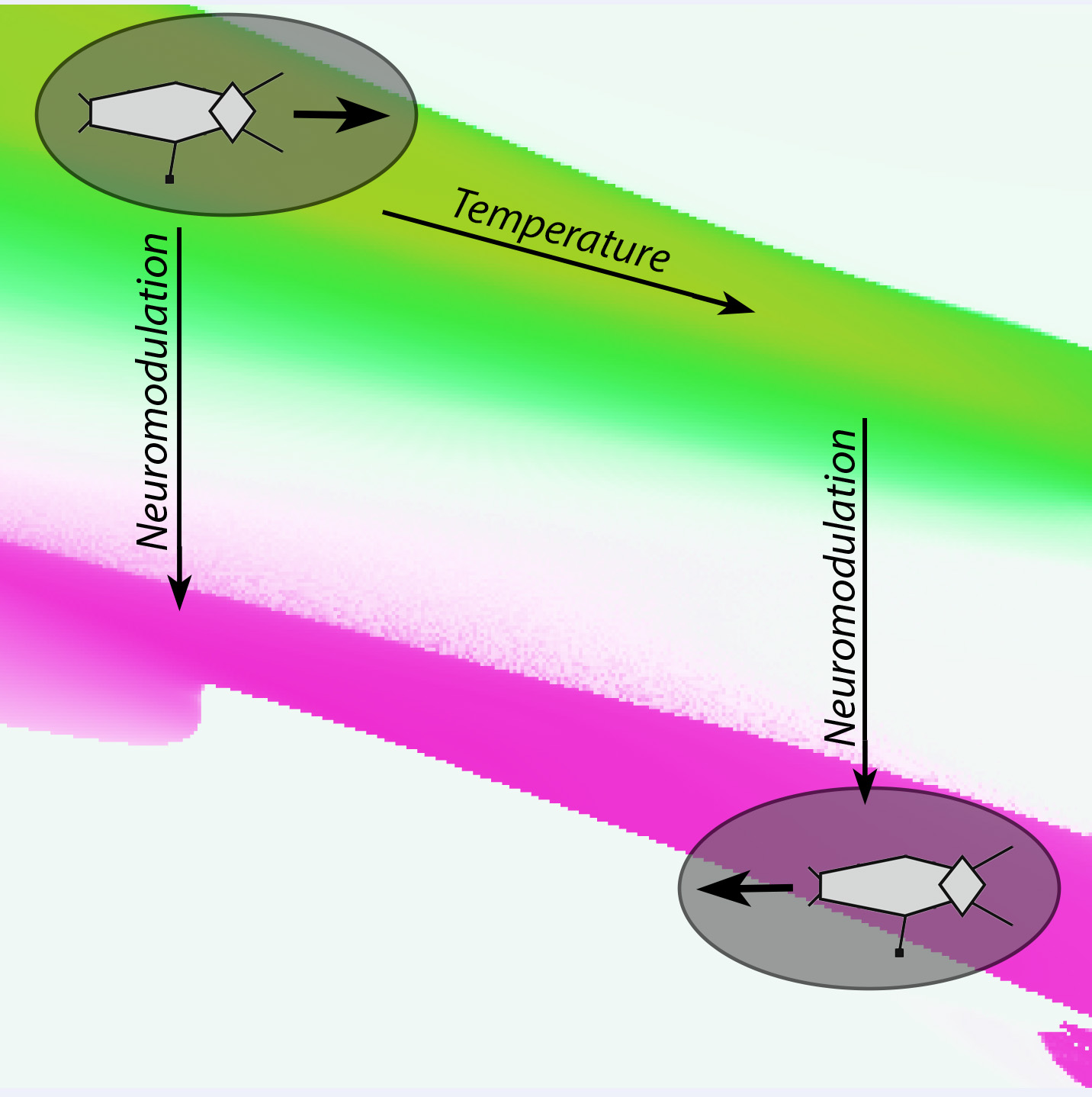
Robustness & Flexiblity Neuromodulation
Lorem ipsum dolor sit amet, consectetur adipiscing elit. Sed eu suscipit orci velit id libero
Read More
Robustness & Flexiblity Neuromodulation
Lorem ipsum dolor sit amet, consectetur adipiscing elit. Sed eu suscipit orci velit id libero
Read More
Robustness & Flexiblity Neuromodulation
Lorem ipsum dolor sit amet, consectetur adipiscing elit. Sed eu suscipit orci velit id libero
Read MoreModeling Software
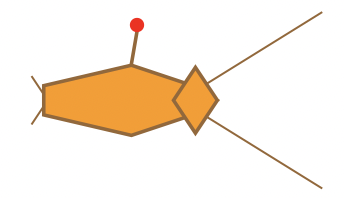
Single Legged CTRNN Walker
GitHub Repository includes base code for the walker in C++ and Python, as well as functionality to evolve walkers and perturb them
My ALIFE Encyclopedia Entry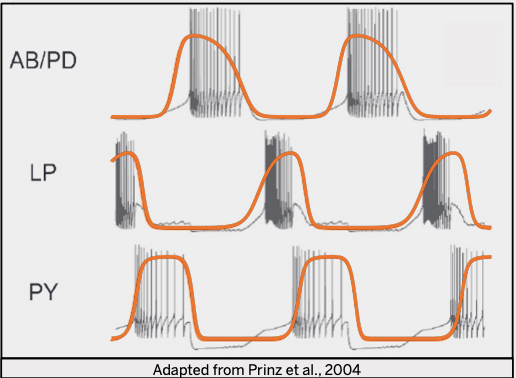
CTRNN Pyloric Rhythm
GitHub Repository includes base code for CTRNNs in Python and C++, as well as a means to evaluate and evolve them for similarity to the pyloric rhythm
ADHP in CTRNNs
GitHub Repository includes base code for the walker in C++ and Python, as well as functionality to evolve walkers and perturb them
My ALIFE Encyclopedia Entry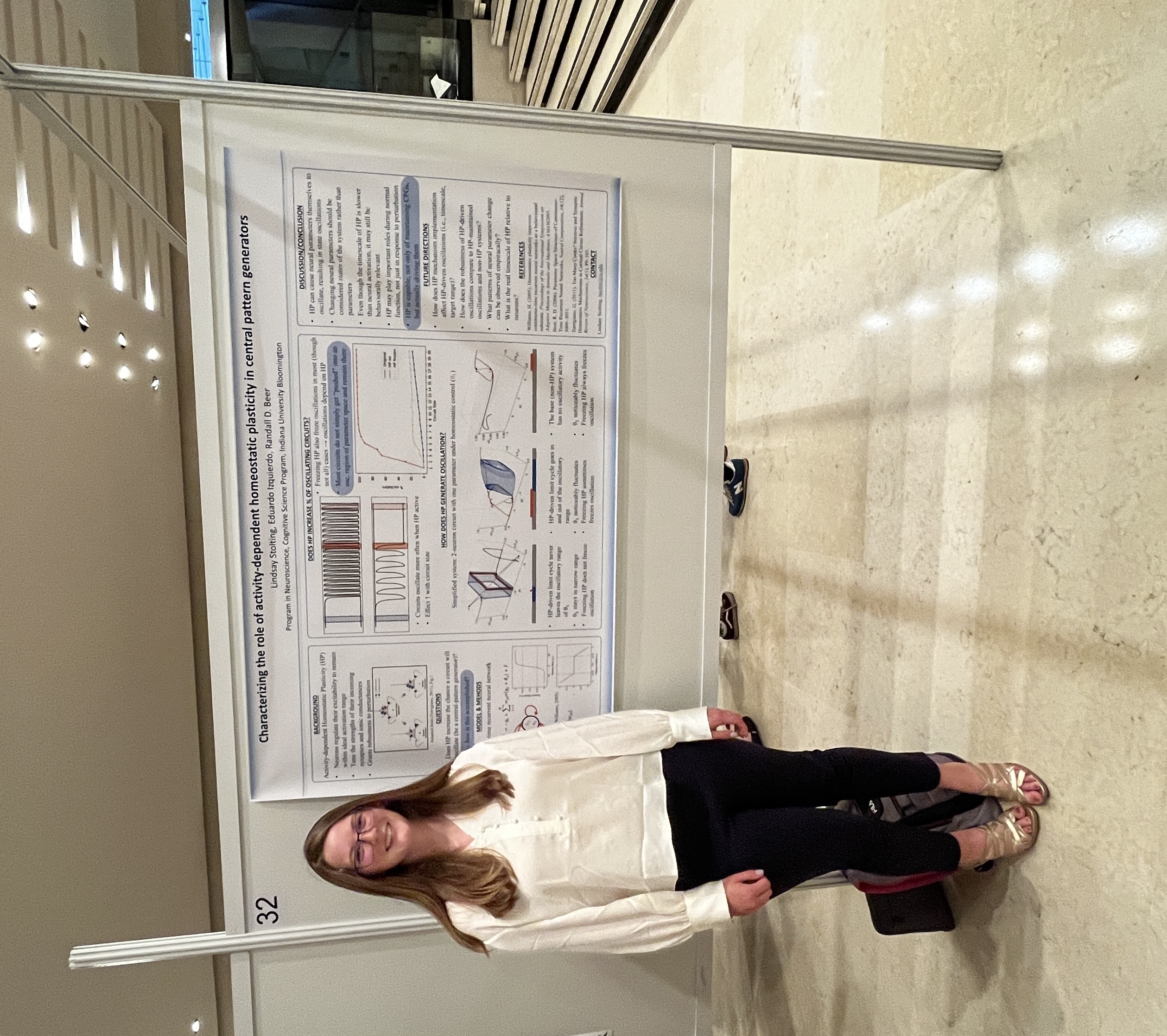
Conference Presentations and Proceedings
Characterizing the role of activity-dependent homeostatic plasticity in central pattern generators Poster PDF
Characterizing the Role of Homeostatic Plasticity in Central Pattern Generators Poster PDF
Characterizing the Role of Homeostatic Plasticity in Central Pattern Generators
Poster Committee Chair, Program Committee Chair, Poster Competition Judge
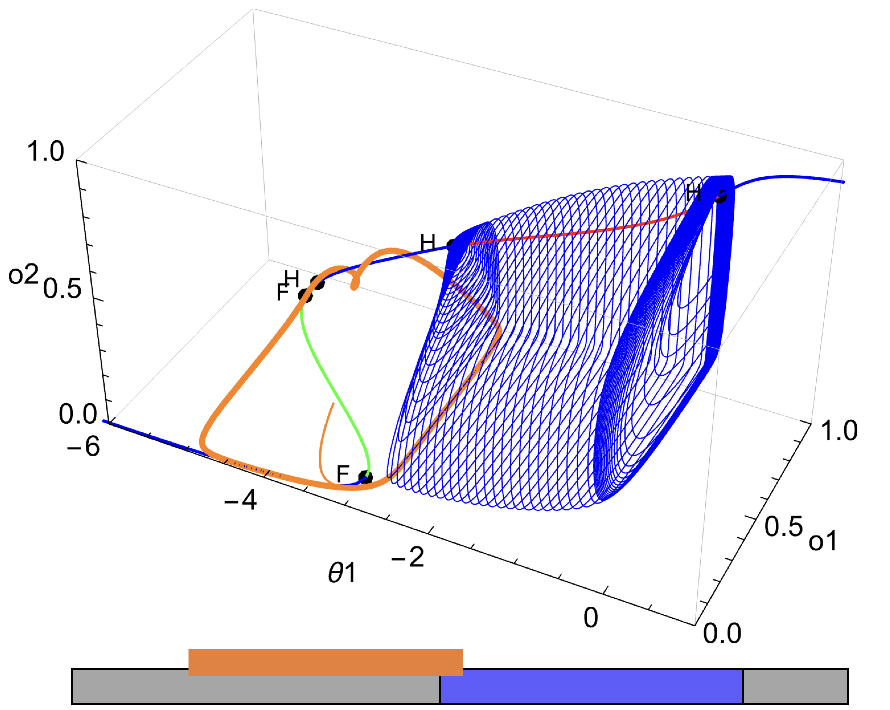
Stolting, L., Beer, R. D., & Izquierdo, E. J. (2023). In Artificial Life Conference Proceedings 35 (Vol. 2023, No. 1, p. 92). PDF
Repository includes base code (Python & C++) for CTRNNs implementing the activity-dependent homeostatic plasticity mechanism introduced by Williams et al. (2005), as well as the analysis carried out in the above conference paper. GitHub
© Lindsay Stolting. Designed by HTML Codex